SATURDAY, AUGUST 15 @ 1 PM EASTERN
Register by 23:59 PM ET on Wednesday, August 12
The 1-Hour Cure
for Impostor Syndrome
For accomplished women who are done talking about it and ready to leave it behind.
Reserve Your SeatListen.
You already know the feeling. Walking into a room, a stage, a job you spent years earning — and thinking, I don't belong here. Staying up late over-preparing for a meeting you're already qualified to run. Downplaying the promotion because some part of you is sure it was luck, or timing, or someone being generous.
You've been told this feeling has a name. Impostor syndrome. And you've been told it's basically universal — that everyone from CEOs to Kate Winslet feel it, so you're in good company.
Except some of us don't feel it.
I know, I don't.
But I still see posts like this online:
"I'm a new partner and am having serious imposter syndrome. I'm so worried that I'm going to mess up, not meet expectations, and disappoint everyone. Like I tricked leadership into promoting me. How do I get over this?"
Good question. And she's not the only one asking it:
"I struggle with imposter syndrome and high sensitivity. I do strong strategic work but need entire weekends in bed to recover, sometimes several days where I can't function."
"I recently got laid off and I'm starting to wonder if I was over my skis and started doubting my abilities."
"I'm finally starting a job outside of retail, in a sector I've been trying to enter for ages. I'm getting major imposter syndrome about it — and I haven't even had my first day yet."
"Got into MBB but now feeling like a complete imposter that's going to be counselled out... and I haven't even started. Does this feeling ever go away?"
"Is anyone else's imposter syndrome running rampant lately? I just feel like I no longer know what I'm doing."
"I just got an offer for £77,000, up from my current £52,000. I'm having cold feet about the new offer. Could this be imposter syndrome?"
"How the F do I get over my imposter syndrome? Rising third year. Really struggling."
The problem is that so many people define it so differently that it becomes very difficult to figure out how one can get over it.
- Some will say it's a skills problem.
- Some will say it's a belief problem.
- Some will say it's a persistent self-doubt because you're having trouble balancing humility with excellence.
- Some will tell you it's an internal individual problem.
- Some will tell you it's an external societal problem.
- Some will say it's the lack of self-awareness.
- Some will say it's too much self-awareness and conscientiousness.
Are you as confused as I am by these?
If this many smart people can't agree on what it even is, how would any of them tell you how to fix it?
The original 1978 Impostor Phenomenon test introduced a confirmation bias.
No matter how you answered the statements, you still got "diagnosed" with impostor feelings. There were no control questions to make sure you weren't accidentally labeled as one. Even answering "not at all true" to all 20 statements still lands you in a labeled category — the test has no floor that reads as "you don't have this."

According to this graphic, the phenomenon got reintroduced into society sometime in 2012–2013, with a much more pathological name: "syndrome" (thanks, Sheryl).
Since then, we seem to have been lumping every flavor of self-doubt under the umbrella of "impostor syndrome." This is why the term has become so paralyzing, even though we keep talking about it, with no clear "cure."
"Impostor syndrome" as a term is quite abstract. And the advice for fixing it is just as abstract.
So what do we have?
Typically, well-characterized conditions tend to converge toward a defined mechanism and protocol as research accumulates. But impostor syndrome content has done the opposite:
- More takes.
- More competing definitions.
- No convergence.
- No protocol anyone agrees on.
No wonder the newly promoted partner is earnestly asking on Fishbowl, "How do I get over this?"
The answer is pretty simple, actually. And it's hidden in your talent DNA.
I do not believe impostor syndrome is an accurate diagnosis.
In August 2021, I was a guest speaker at a mastermind for entrepreneurs, helping them understand their talent DNA a.k.a. their zone of genius.
At some point, the topic of impostor syndrome came up, and the energy in the room just dropped. Someone asked me,
"How do you overcome imposter syndrome?"
And I said,
"Imposter syndrome doesn't exist for me."
Which is true.
I don't feel like a fraud, or that I'll be found out.
But that doesn't mean I don't experience self-doubt.
I experience plenty of it, every day, about all sorts of things.
Because it's an absolutely normal, natural human experience.
After that session, one of the participants, Michelle, emailed me:

That email sent me down a rabbit hole. A few months earlier, I'd been on a quarterly call with over 100 certified coaches from Europe and other continents.
Only 4 professional development coaches out of 100 knew what impostor syndrome even was.
Every one of those four had ties to the United States.
Don't you find this intriguing?
So I started digging into the origins of the imposter phenomenon and when I realized it had introduced a confirmation bias I also noticed some parallels with what clients have been telling me.
Imposter syndrome experts say that if you say this:
"If I can do it, anybody can."
Or this:
"I feel like I'm winging it, and I will be found out."
It affirms your imposter feelings.
But do you know who else typically says this? Everyone who takes their own talents for granted.
When you are naturally great at something, you don't think of it as anything special. You indeed think that if you can do it, anybody else can. But strengths-based psychology will tell you that what comes naturally and easily to you doesn't come naturally and easily to another person.
Want to know what's behind your own "I'm winging it"?
Join me at the workshop and I'll show you how and why you may have been overlooking or mistaking your natural talents for impostor feelings.
What it feels like once you truly understand your talent DNA
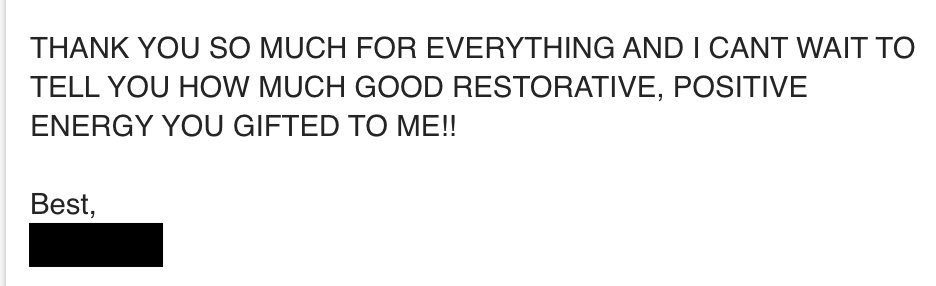
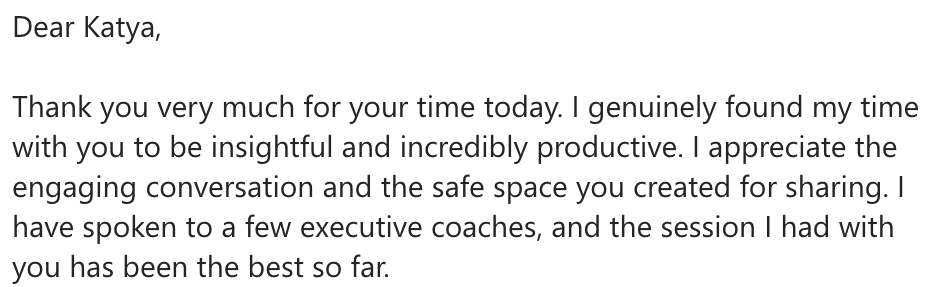
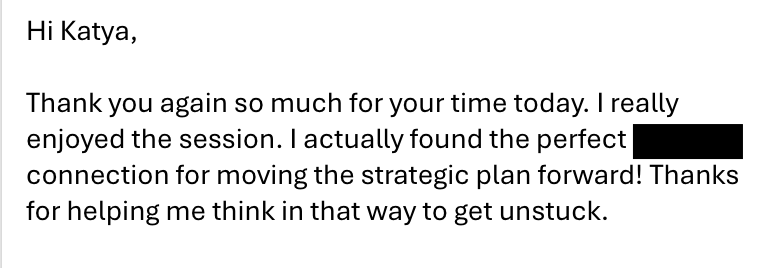
These messages came in after these women spent just one hour in a conversation with me for the first time.
This is why I can say with 100% certainty that the cure to the impostor feelings and any lack of confidence is in understanding your natural wiring.
"I've had multiple coaches, ones I've paid for, ones that companies have paid for, and I've had a therapist… but I've never had a coach to help me really understand me, not just the challenge I'm facing or the immediate fire that's going on."
"Katya works to understand you and pushes you to be uncomfortable in all the best ways so you can be more authentic. She is so good at what she does, and she is also so authentic herself. That really resonated with me and helped me be more open. She showed me how to recognize my own strengths and be confident in them. I learned how to completely change the way I told my story."
"The most valuable part was using real-life situations. She would review my version of something and provide suggestions that I could learn from. I couldn't believe how spot-on and specific her suggestions were. Having help to go back long in my career and tie it all together was incredibly valuable. She helped me remember things I did in the past—just her questions and curiosity made that happen."
Hi, I'm Katya Nicholas.
My journey to becoming an executive advisor and a career strategist has made one thing certain...
...understanding your Talent DNA is the key to transforming your career environment and, if necessary, trajectory.
I've worked with women who have led global teams, managed billion-dollar businesses, scaled organizations across continents, and held senior roles at companies including Autodesk, DocuSign, LinkedIn, Uber, Zendesk, and Cloudflare, to name a few...
And beneath those extraordinary résumés, I found the same recurring tension: they could articulate the value of their teams, their companies, and their strategies far more easily than they could articulate their own.
No wonder some of them feel like impostors. And I'm on a mission to remove those impostor feelings from everyone's vocabulary and yes, from that Google Ngram Viewer.

- You'll get an email confirmation with all details for the workshop.
- Within 2 days after registration, you'll get a code for an assessment that identifies your natural Talent DNA. Take the assessment before the workshop if you want guidance tailored to what might actually be causing you to think like an impostor.
- Two days before the workshop, you'll receive a unique Zoom link for the session.
When is this, exactly?
Saturday, August 15, 2026, 1:00 PM – 3:30 PM Eastern.
How much does it cost?
$297.
Is this a group session or one-on-one?
Group — capped at 15 people.
Is it live-only, or is there a replay if I can't make it?
It's live. You need to attend live to get tailored feedback about your challenges. Every participant will receive a recording of the session.
Is the assessment included in the price, or a separate cost?
The assessment is included in the price.
What actually happens in the workshop? Is it a lecture, or do I get personalized feedback?
The title says "1-Hour Cure" to indicate the speed at which you'll get a mind reset — you'll stop looking at your challenges as impostor syndrome. The workshop itself runs 2.5 hours, since it includes both theory and practical recommendations. After the theoretical part (~20 minutes), you'll be able to ask questions and get personalized advice.
"1-Hour Cure" is a bold claim — is this really a full fix, or a starting point?
It's both. I'm 100% confident you'll stop looking at your challenges as impostor syndrome. You'll start paying attention to your natural wiring and get into the habit of seeing your talent DNA as a unique value proposition. I'm known for delivering insights faster than most practitioners, and frankly, I have no interest in keeping people in pain believing they're impostors.
I don't fully relate to "impostor syndrome" — is this workshop still for me?
Yes. Self-doubt has many different flavors. Your talent DNA has answers for all of them.
What if the assessment results confuse me before the workshop?
You don't have to understand the assessment results before the workshop. You'll get all the answers you need from me live.
What's the cancellation/refund policy if I can't attend at the last minute?
Once you register, you're expected to attend live. If you don't get any value from the workshop after attending, you'll get your money back.
I want to preserve my anonymity — how can I participate if I want to ask questions?
You'll be able to preserve your anonymity during the workshop. I don't require you to be on camera if you don't want to. You can also change your Zoom username to something abstract, like "Participant 1."
© 2026 Katya Nicholas. All rights reserved.
Terms & Conditions | Privacy Policy
Designed with intention in New York. Serving clients worldwide.
This site is not a part of the Facebook™ website or Facebook™ Inc. Additionally, this site is NOT endorsed by Facebook™ in any way. FACEBOOK™ is a trademark of FACEBOOK™, Inc.